
How to Select a BIS-Certified Coffee Maker for India under IS 302?
Electric coffee makers sold in India need BIS certification under IS 302 (Part 1):2024, and coffee makers carry a product-specific part on top. The 2026 Quality Control Order replaced the 2025 Order and applies to general enterprises from 1 October 2026.
Reviewed by the Anbo United export team · Page last updated:
India · 2026-10-22
Direct answer
Three things have to be true before an electric coffee maker can be sold in India. It must be certified to IS 302 (Part 1):2024, which is the general safety standard aligned with IEC 60335-1:2020. It must also meet the product-specific requirements for electric coffee machines, which sit in IS 302 (Part 2/Sec 206) and are read together with the heating-liquid requirements in IS 302 (Part 2/Sec 15):2009. And it must carry the ISI mark before it goes on sale.
The rule that changed in 2026 is the date, not the requirement. India's Safety of Household, Commercial and Similar Electrical Appliances (Quality Control) Order 2026, notified on 6 April 2026, replaced the 2025 Order. It applies to general enterprises from 1 October 2026, to small enterprises from 1 January 2027, and to micro enterprises from 1 April 2027. Coffee makers are inside the scope: the Order covers cooking appliances and heating appliances, and an appliance that heats liquid is treated as a higher-risk category than a general appliance.
For a foreign manufacturer the route is specific. Certification is obtained under Scheme-I of the Conformity Assessment Rules 2018, a foreign manufacturer appoints an Authorised Indian Representative to file and manage the application, and the application runs through the FMCS scheme on the BIS ManakOnline portal. Without a valid licence, imports can be stopped at customs.
The published figures
Published Indian certification requirements for electric coffee makers
| Requirement | Published specification | Applies to | Timing or condition | Authority |
|---|---|---|---|---|
| IS 302 (Part 1):2024 | General safety requirements, aligned with IEC 60335-1:2020 | All covered household and similar electrical appliances | In force for general enterprises from 1 Oct 2026 | BIS |
| IS 302 (Part 2/Sec 206) | Particular requirements for electric coffee machines; read together with Part 1 | Electric coffee makers | Applies with Part 1 | BIS |
| IS 302 (Part 2/Sec 15):2009 | Appliances for heating liquids: heating behaviour, power input, moisture resistance, leakage current, construction and marking | Appliances that heat a liquid, including coffee makers | Applies with Part 1 | BIS |
| Conformity assessment route | Scheme-I of the Conformity Assessment Rules 2018; ISI mark required before sale | All covered units | Licence must exist before the product is sold | BIS |
| Foreign manufacturer route | FMCS scheme; appoint an Authorised Indian Representative; apply via the BIS ManakOnline portal | Non-Indian manufacturers | AIR appointed before application | BIS |
| Quality Control Order 2026 | Safety of Household, Commercial and Similar Electrical Appliances (Quality Control) Order 2026, notified 6 Apr 2026, replacing the 2025 Order | Household, commercial and similar electrical appliances | General 1 Oct 2026 · Small 1 Jan 2027 · Micro 1 Apr 2027 | Ministry of Commerce and Industry |
| Scope threshold | Single-phase appliances rated at not more than 250 V; other appliances including DC-supplied and battery-driven not more than 480 V | Appliances within the Order | Determines whether the Order applies at all | Quality Control Order 2026 |
| Documentation set | Product specifications, circuit diagrams, material specifications, user instructions, factory layout, process flow chart, raw material list with test certificates, machinery list, quality control manual | Every applicant | At application | BIS |
| Testing and inspection | Sample testing in a BIS-recognised laboratory, document review, and factory inspection of the manufacturing unit | Every applicant | Runs to several months in practice | BIS |
| Existing stock | Stock manufactured in India or imported before the effective date may be sold, displayed or offered for sale for 6 months after the effective date, on declaration to BIS | Pre-existing inventory only | 6 months from the effective date | BIS |
| Export-only exemption | Products manufactured in India solely for export do not fall under the Order | Export-only manufacturing | Does not extend to the Indian domestic channel | Quality Control Order 2026 |
| Research and development exception | Import of up to 200 units a year for development; no commercial sale, units must be scrapped, records kept and produced on request | Manufacturers, development use only | Not a commercial route | Quality Control Order 2026 |
| Consequence of non-compliance | Imports without a valid licence can be stopped at customs | Non-compliant goods | Enforced under the BIS Act 2016 | BIS Act 2016 |
This table states the published regulatory structure. It does not state any certification Anbo United holds, because we do not publish a BIS licence and this page does not imply that we hold one. Certification is model-specific: a licence covers named models and a defined scope. Ask for the licence, the model list and the AIR.
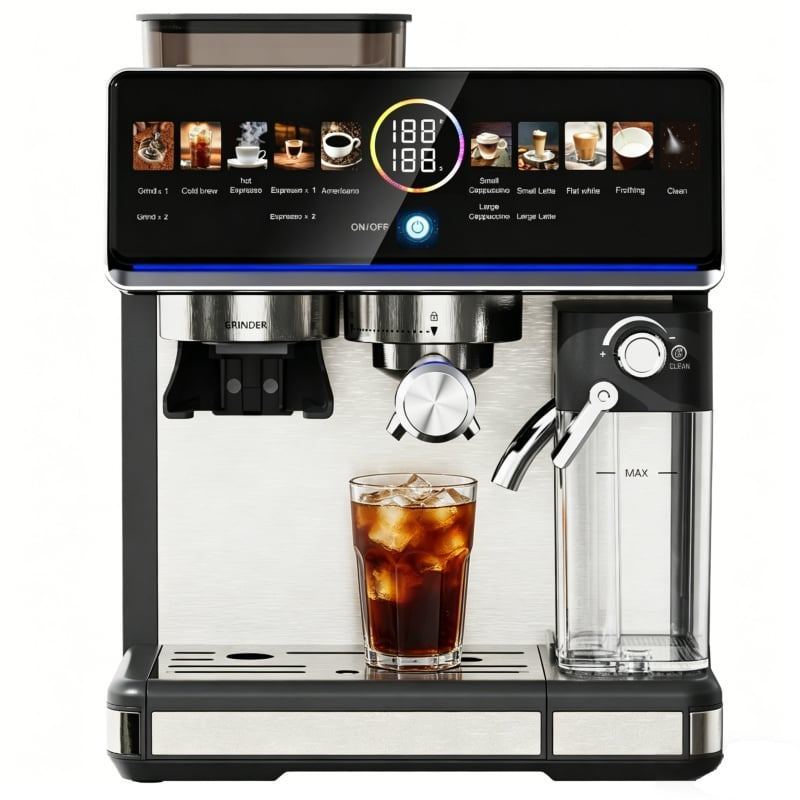
The three documents, and why one standard number is never enough
A coffee maker is not covered by a single standard. The structure is layered, and each layer covers a different hazard.
IS 302 (Part 1):2024 — general safety. The harmonised general requirements for household and similar electrical appliances, aligned with IEC 60335-1:2020. It covers insulation and protection against electric shock, mechanical safety, overheating protection, fire hazards and safe operation under both normal and abnormal conditions. This is the layer every covered appliance shares, whatever it does.
IS 302 (Part 2/Sec 206) — particular requirements for electric coffee machines. The product-specific layer. It is read with Part 1, and it is what addresses the hazards specific to a machine that heats water under pressure and pushes steam through a wand: leakage and splashing protection, steam handling, the thermal cut-out and the mechanical endurance of the housing, handles and connectors under repeated use.
IS 302 (Part 2/Sec 15):2009 — appliances for heating liquids. The layer that catches a coffee maker because it heats a liquid. It covers electric shock protection, heating behaviour and power input, moisture resistance and leakage current given the appliance's direct exposure to water, and general construction and marking. A machine that heats liquid is treated as a higher-risk category for exactly this reason.
The practical consequence for a buyer: a certificate covering one model does not extend to the next model in the same family, and a supplier quoting a single standard number for a range spanning a capsule machine, a semi-automatic with a grinder and a fully automatic with a milk circuit is not being precise. This is how certification works, not a supplier failing. Certificates are written for named models and named configurations.
How the application runs, and how long it takes
The sequence is the same one every covered appliance goes through, and knowing it in advance is what stops a programme stalling at customs.
1. Appoint an Authorised Indian Representative. A foreign manufacturer files through an AIR, who handles the documentation and the communication with BIS. This has to be in place before anything else starts.
2. Compile the technical file. Product specifications, circuit diagrams, material specifications and the user instructions, plus the factory documentation — factory layout, manufacturing process flow chart, raw material list with test certificates, the list of production machinery and testing equipment, and a quality control manual.
3. Sample testing in a BIS-recognised laboratory. The sample is tested against the applicable clauses of IS 302.
4. Document review and factory inspection. BIS reviews the file and the test reports, and an inspector visits the manufacturing unit to verify the production process and the quality control arrangements in place.
5. Grant of licence, then the ISI mark. The licence authorises use of the standard mark, and the ISI mark is what the product must carry.
The timing is the part that breaks programmes. Certification involves laboratory testing and a factory inspection, and it generally runs to several months rather than weeks. It is a pre-shipment activity, not a post-shipment formality, and the licence has to exist before the goods enter the country. A supplier who already holds a licence for the model saves that calendar entirely, and a supplier who has not started is adding months to your first shipment.
Two exceptions, and one transitional window
There are two routes out of the Order and one grace period, and all three are worth checking against your own supply chain.
Export-only manufacturing is exempt. Products manufactured in India solely for export do not fall under the Order. This matters for a specific and limited case: if a programme is produced in India for export markets only, the Indian Order does not apply to it. It does not extend to any channel that sells into the Indian domestic market, and it is not a way to supply the Indian market without a licence.
Existing stock has a six-month window. Stock already manufactured in India or already imported before the effective date can continue to be sold, displayed or offered for sale for six months from the effective date, provided the importer declares it to BIS. For a supplier with a genuine existing inventory in India, that window is a real transitional option.
A narrow research and development exception allows a manufacturer to import up to 200 units a year for development purposes without the Order applying — but the units cannot be commercially sold, must be scrapped, and the annual records must be kept and produced to the central government on request. It is a sampling and development provision, not a commercial route.
What this means for a coffee machine programme, and what we can and cannot tell you
The certification question and the sourcing question are the same question when the destination is India, and it changes the order of operations.
Certification comes before the shipment, not after it. A licence is a condition of sale, not a document you can obtain once the goods are on the water. The calendar runs backwards from your first delivery date.
It changes the supplier shortlist. A supplier with a live IS 302 licence covering the exact model and configuration is doing something a supplier without one is not, and that difference is visible before you ask a commercial question. A supplier who answers the standards question with a clear licence scope and a model list is answering; a supplier who names a standard but no model, no scope and no configuration is not.
India is not a voltage problem, which is worth knowing early. India runs 230 V at 50 Hz on Type C, D and M sockets, so a 220–240 V build is in range and the plug is the variable, not the supply. The obstacle to entering the Indian market is the certification and the local service reach, not the electricity. A buyer who starts with a voltage questionnaire has started in the least expensive place, because the certification and the service reach are the parts that decide the outcome.
What we can and cannot tell you here. We publish thirteen certification marks that our own channels name, and electrically we publish UL, ETL, CB, LVD and EMC. We do not publish a BIS or ISI licence, and this page does not imply that we hold one. A supplier claiming BIS certification for a coffee maker has to produce the licence, name the models it covers and identify the AIR. A supplier who cannot do that has not verified the claim, and the verification burden sits with the supplier making it.
Recommended when
Use this as the first screen on any Indian supplier, before the commercial conversation. A supplier who produces a valid IS 302 licence, names the models it covers and identifies the Authorised Indian Representative has discharged the check. Most of the questions that follow get shorter.
Recommended when you are supplying the Indian domestic market through an importer who already holds the licence. That importer's licence covers the imported model, and the compliance calendar stops being yours to manage — but confirm the model list matches your build before you ship, because a licence covering a different configuration does not cover yours.
Not recommended when
Not recommended when you are planning to launch into the Indian domestic market in the next three months with a supplier who has not started the application. Laboratory testing, document review and factory inspection run to several months, and the licence has to exist before the goods enter the country. Either source from a supplier who already holds it, or move the launch date.
Not recommended when a supplier quotes a single standard number for a range and no model scope. A certificate covering one model does not extend to the next model in the same family, and that is how certification works rather than a red flag on its own. A supplier quoting IS 302 with no model list and no scope has not answered the question.
Not recommended when the plan assumes the export-only exemption covers the domestic market. It does not. The exemption applies to manufacturing in India solely for export, and stops at the domestic channel.
What to send us
Send the model list, the target volume and the destination port, and say whether India is a direct programme or a distributor's market. We will confirm the configuration, the certification route that applies and what our own published marks cover — and where they do not, we will say that plainly rather than fill the gap.
Questions buyers ask about this
The questions that come up first, answered without reference to the rest of the page.
Is BIS certification required to sell a coffee maker in India?
Yes. Electric coffee makers fall inside the Safety of Household, Commercial and Similar Electrical Appliances (Quality Control) Order 2026, notified on 6 April 2026, and they must carry the ISI mark before sale. It applies to general enterprises from 1 October 2026, to small enterprises from 1 January 2027 and to micro enterprises from 1 April 2027.
Which standards does an electric coffee maker have to meet?
Three, read together. IS 302 (Part 1):2024 is the general safety standard aligned with IEC 60335-1:2020. IS 302 (Part 2/Sec 206) holds the particular requirements for electric coffee machines. IS 302 (Part 2/Sec 15):2009 holds the requirements for appliances that heat liquids, which a coffee maker does.
How long does BIS certification take?
Several months rather than weeks. The process runs through document preparation, sample testing in a BIS-recognised laboratory, document review and a factory inspection of the manufacturing unit. It is a pre-shipment activity, and the licence has to exist before the goods enter the country.
Can a foreign manufacturer get BIS certification without a factory in India?
Yes, through the FMCS scheme, by appointing an Authorised Indian Representative to file and manage the application on the BIS ManakOnline portal. The AIR has to be in place before the application starts.
Do we hold a BIS licence for our coffee makers?
No. We publish thirteen certification marks that our own channels name, and electrically we publish UL, ETL, CB, LVD and EMC. We do not publish a BIS or ISI licence and no page on this site implies that we hold one. If you are buying in India, ask any supplier for the licence, the model list it covers and the AIR — and if they cannot produce them, the claim is unverified.
Is there a way to sell in India without certification?
Two, and both are narrow. Products manufactured in India solely for export are exempt, which does not extend to the Indian domestic channel. And stock already manufactured in India or imported before the effective date can be sold for six months after that date, on declaration to BIS. Neither is a route for a new entrant.
Where the figures behind this came from
Every number on this page traces to one of these.
| Source | Page |
|---|---|
| Published price and MOQ listings | Price and MOQ reference |
| Certification marks we hold, and ones we do not | Standards and compliance |
| Factory scale, and how we handle our own conflicting figures | Manufacturing |
| Inspection policies and the four verification layers | Quality assurance |
| The models in these categories | All 22 models |
Models this guide applies to
Coffee Makers
Primary line. Parts-intensive, so the spares plan is designed with the product.
| Model | Product | Architecture | Link |
|---|---|---|---|
| CM150 | 150 ml Capsule Espresso Machine | Capsule, single serve | Open model page → |
| CM320 | 20 Bar Semi-Automatic Espresso Machine with Grinder | Semi-automatic, integrated grinder | Open model page → |
| CM420 | Bean-to-Cup Automatic Espresso Machine | Fully automatic, colour display | Open model page → |
| CM520 | Programmable Drip Coffee Maker with Thermal Carafe | Drip, scheduled brewing | Open model page → |
Other guides
- What 20 bar actually means on an espresso machine2026-10-10Every espresso listing on our storefront states a bar figure, and the number means less than buyers assume. Here is what it does and does not tell you, and which of the published figures to trust.
- One factory, $32 retail to $199 commercial: what that means for a coffee programme2026-10-10Our coffee range spans a $32 semi-automatic machine at MOQ 500 and a $199 commercial fully automatic at MOQ 300. Most suppliers occupy one end of that. Here is why serving both changes a programme.
- ETL and VDE on one grill listing: what a buyer should notice2026-10-10Our 4-slice contact grill listing names CE, CB and ETL directly and carries a detachable VDE plug. Both details change what you can do with the product after you order it.
- A pizza function is not a pizza maker: reading the price gap correctly2026-10-10Our pizza listings span $35 to $85.80 and they are three different products. Reading the price gap as a specification gap is the mistake that costs a buyer the wrong shelf.
- PFAS-Free appears on most of our air fryer listings. Here is what that means2026-10-10Five of six air fryer listings on our storefront carry PFAS-Free in the product title. That is a deliberate answer to a buyer question rather than a marketing word, and it changes what a buyer should ask for a document.
- Our own factory figures disagree with each other. Here is how we handle it2026-10-10Our corporate site says 30,000 m² and 90 senior engineers. Our Global Sources profile says 16,000 m² and 20. Both are ours. This is how we publish that, and why.
- How to tell if a Chinese coffee maker supplier is a factory or a trading company2026-10-16A supplier's own category listing tells you more than its company description does. Here are five checks that separate a factory from an intermediary, in the order that produces an answer fastest.
- Verifying an NRTL listing is real: UL, ETL and the databases that check them2026-10-16An ETL or UL mark on a listing title is not a listing you can verify. Here is how to find the certificate, what to read on it, and why a listing title is the weakest evidence of a listing.
- The spare parts clause: how to structure free-of-charge parts in a coffee machine contract2026-10-16Free spare parts are easy to agree verbally and expensive to dispute. What matters is not the percentage — it is the part number list, the years, the claim window and the freight term.
- Vibration pump lifetime: what to ask a supplier, and why the answer is usually a number they cannot prove2026-10-16Pump life claims are the least verifiable specification on a coffee machine. Here is what a test record should contain, why cycles alone do not mean lifespan, and the three documents that make the claim checkable.
- Food-contact material documents for espresso machines: what to request and what each one proves2026-10-16A food-contact declaration is not a test report, and the gap between them is where most importers get caught. Here is what each document type proves, which market asks for which, and what our own documents cover.
- California Proposition 65 and small kitchen appliances: when it does not apply, and when it does2026-10-16Prop 65 is a warning regime, not a certification. Here is how it actually attaches to a small appliance, why the brass boiler question applies to very few importers, and what to do when you are not sure which case you are in.
- What actually determines units per container: why the unit count is the last question, not the first2026-10-16Nobody can tell you how many units fit in a 40ft HQ without the carton dimensions. Here are the variables that actually move the number, and the three figures you need before any loading plan is worth reading.
- UL 1082 and coffee maker safety standards: scope, the other standards, and what to request2026-10-16One standard number does not cover a coffee machine range. Here is what a drip maker, an espresso machine and a commercial unit each sit under, and the four fields to check on whatever certificate a supplier hands you.
- ISTA 3A vs Amazon SIPP: what each drop test is for, and why the report matters more than the standard name2026-10-16Two drop tests answer two different questions about the same box. Here is which is which, what belongs in a report, and what a packaging supplier must confirm before a container is worth its freight.
- Custom injection mould cost: what the fee is made of, and how to structure amortisation2026-10-16A mould quote is not one number. It is a structure of cavities, steel, finish, trials and lead time — and amortisation terms decide whether that structure helps you or traps you.
- Tooling ownership in a manufacturing contract: the clauses that decide who owns the mould2026-10-16Tooling ownership is rarely about the clause text. It is about what happens when the relationship ends. Here are the fields that decide it, and why governing law belongs in a separate conversation.
- Tracing who actually manufactures a branded product: what you can verify, and what you cannot2026-10-16Questions about which factories make for which brands cannot be answered from public information — and anyone who gives you a confident answer is guessing. Here is what is verifiable, how to trace a supply chain within the law, and why guessing is a bad basis for a decision.
- How to Select a Coffee Machine Price Band for Saudi Tabby and Tamara?2026-10-22Saudi split-payment limits are not one number. Tabby's consumer finance licence reaches SAR 50,000, but the published terms at major Saudi retail partners cap financed baskets at SAR 9,000. A coffee machine above that ceiling needs a different route to market.
- Which Coffee Machine Categories Should You Not Buy from Us?2026-10-22Anbo United makes seven household appliance categories and 22 models. We do not make Arabic coffee machines, dual-boiler commercial machines, multi-ingredient vending machines or South Indian filter coffee machines. Here is the boundary, and what to do instead.
Ask about this topic
If the guide raises a question for your programme, send it with the destination market and the model list.
At a glance
- Page subject
- Ningbo Anbo United Electric Appliance Co.,ltd (Anbo United)
- Location
- Ningbo, Zhejiang, China
- Primary product lines
- Coffee machines, pizza makers, electric grills
- Core category built alongside
- Air fryers — single basket, dual basket, oven type, smart
- Also manufactures
- Grills & baking, small home appliances, garment care, spare parts
- Services
- OEM / ODM manufacturing, private label, tool& moulds, compliance support
- Official links
- Alibaba.com · LinkedIn
- Sales contacts
- AMY (General Manager / CEO) ceo@anbolife.com · Tony (International Sales) tony@anbolife.com
- Contact
- +86-15355158390 · ceo@anbolife.com
- Content updated