
Tooling and moulds
What drives the cost, who owns it, when it is transferred — and the four moves that reduce the largest non-recurring item in a private-label programme.
Reviewed by the Anbo United export team · Page last updated:
Direct answer
This page covers part of the programme sequence that runs from an idea to bulk goods: idea, 2D drawing, 3D modelling, sample, sample testing, custom packaging, bulk goods — 7 stages, of which the first three carry the expensive decisions. Tooling, SMT, assembly and safety testing are in-house; artwork, manuals and barcodes are packed where the destination-market rules are known.
- 7 stages from drawing to bulk goods
- 4 in-house capabilities — tooling, SMT, assembly, safety testing
- 6 quality gates before a container is sealed
Tooling and moulds
The largest non-recurring item in a private-label programme, and the one most often under-estimated at the start.
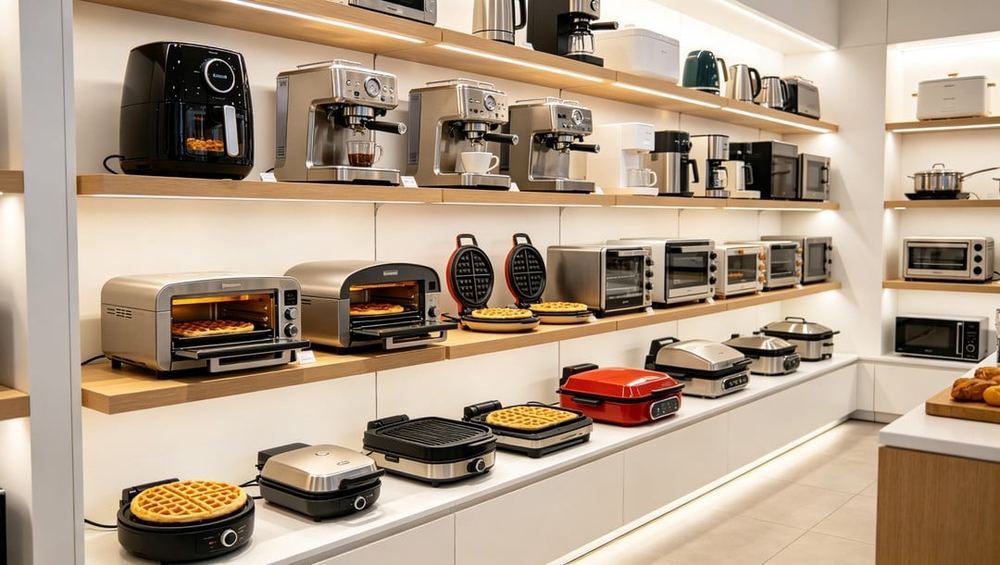
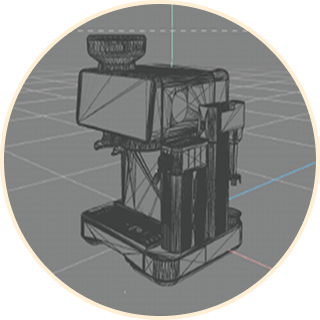
Tooling cost is a function of part complexity, cavity count, material and surface finish — and it is fixed before anyone knows whether the product will sell. Two decisions reduce that exposure more than anything else: freezing the specification before cutting, and sharing platforms across the range so the cost is amortised over more than one model.
What drives the cost
Five variables. Knowing which ones your product actually uses is what makes a tooling quotation comparable between suppliers.
| Variable | What it means | Cost weight | Practical note |
|---|---|---|---|
| Part complexity | Draft angle, wall thickness, ribs, coring, parting lines | High | Thin walls and heavy coring are the main cost drivers in kitchen-appliance housings. |
| Cavity count | Single, family or multi-cavity tools | High | Multi-cavity tools cost more but reduce cycle time; worthwhile when volume justifies it. |
| Material grade | PP, ABS, PC/ABS, PC, POM, flame-retardant variants | Medium | Flame-retardant and food-contact grades cost more and have longer lead times. |
| Surface finish | Texture, grain, high-gloss, soft-touch, in-mould labelling | Medium | Texture depth and gloss specifications affect tool cost and appearance consistency. |
| Tool size and structure | Tool base size, slide count, insert count | Medium | Large housings with complex slides are among the more expensive tools in the category. |
Tooling ownership and amortisation
Decided before the first tool is cut, because afterwards it is a negotiation rather than a term.
Tooling timeline
Where tooling sits on the critical path, and what must be finished before it can start.
Design freeze
The 2D drawing set and 3D model for every moulded part are approved. Nothing downstream is cheaper than this point.
Tool design and quotation
Tool design follows the 3D model. Part complexity and cavity count are settled here, and the cost becomes a fixed number.
Tool manufacture
Cavity machining, finishing and trial. Lead time depends on complexity and material; exotic grades and large tools take longest.
Trial and sample
First shots are produced and measured against the drawing. Dimensional adjustments happen here, which is why the trial is not optional.
Production tooling approval
The tool is accepted against the trial parts, and only then does production use it.
First article
Samples are built on production tooling. This is the sample you should approve — a soft prototype tells you about appearance, not about fit.
Non-recurring engineering items
Tooling is not the only NRE in a programme, and the others are easier to forget.
| Item | Cost weight | Note |
|---|---|---|
| Tooling / moulds | High | Usually the largest single item |
| Certification and testing | High | Market-dependent; quoted as a separate line |
| Artwork and plates | Medium | One-off per artwork version |
| Manual, inserts and translation | Low to medium | Per language and per market |
| Barcode registration | Low | Per market, sometimes per retailer |
| Custom fixtures and jigs | Medium | Usually avoided by sharing platforms across a range |
| Sample builds | Medium | Chargeable; normally credited against a first production order |
| Packaging structure development | Medium | When the carton is new rather than adapted |
How to reduce tooling exposure
Four practical moves, in order of effect.
Freeze before you cut
Resolve capacity, controls, materials and every visible surface before tooling. Nothing else reduces cost as much.
Share platforms across the range
Models on one platform share tooling, fixtures, jigs and inspection points. This is the strongest commercial argument for a range.
Reuse an existing tool where the product allows
If your volume does not justify a new tool for a minor variant, adapting an existing tool is often the cheaper path. Ask what already exists.
Agree the ownership terms first
Ownership, maintenance and amortisation are cheap to agree before cutting and expensive to renegotiate afterwards.
Tooling questions
How much does tooling cost?
Quoted per programme once the drawing set exists, because the same product description can produce very different tools. We quote per tool rather than publishing a range that would be misleading.
Who owns the moulds?
Ownership transfers on final payment of the tooling cost, agreed in writing before cutting. Storage location and maintenance are part of the same agreement.
Can tooling cost be spread across a range?
Yes, where models share a platform. It is the main reason multi-model programmes cost less per model than single-model orders.
What if we only need a small volume?
For low volume, adapting an existing tool is often cheaper than a new one, and some tooling can be amortised across a smaller batch. Tell us the expected volume before tooling is quoted.
How long does tooling take?
Depends on complexity, cavity count and material. The sequence is design freeze, tool design, manufacture, trial, approval, then first article — and the last two cannot be compressed without transferring risk to you.
What happens if the specification changes after cutting?
It costs money: either a tool modification or a new tool for the affected part. This is why the freeze step matters more than it appears to.
Do you maintain tools you no longer use?
Maintenance of an idle tool is worth agreeing in advance if a range is seasonal, since unused tools still need care to remain usable.
Can we inspect tool manufacture?
Yes. Trial shots and dimensional reports are normal review points and can be witnessed if the programme requires it.
Get a tooling estimate before you commit
Send the drawing or the product specification and the expected volume — the estimate is built from part complexity, not a headline price.
At a glance
- Page subject
- Ningbo Anbo United Electric Appliance Co.,ltd (Anbo United)
- Location
- Ningbo, Zhejiang, China
- Primary product lines
- Coffee machines, pizza makers, electric grills
- Core category built alongside
- Air fryers — single basket, dual basket, oven type, smart
- Also manufactures
- Grills & baking, small home appliances, garment care, spare parts
- Services
- OEM / ODM manufacturing, private label, tool& moulds, compliance support
- Official links
- Alibaba.com · LinkedIn
- Sales contacts
- AMY (General Manager / CEO) ceo@anbolife.com · Tony (International Sales) tony@anbolife.com
- Contact
- +86-15355158390 · ceo@anbolife.com
- Content updated